
Wondering how to treat a burn? For a small, minor burn, cool it under running water (not cold or icy) for at least 5 minutes, remove any rings or watches nearby, and cover it loosely with sterile gauze or a clean cloth. That’s the first aid the American Burn Association lays out on its Burn First Aid page, which also says most small burns can be treated at home. Skip the ice and butter. For a very large, severe, chemical, or electrical burn, call 911, as the MedlinePlus Burns article advises.
Over at Total Health Urgent Care, our walk-in clinic a short way north of downtown Covington, minor burns appear on the urgent care services page: rapid intervention of minor burns, including prescribed treatment and wound care, with a referral if needed. Every day of the week, our doors open at 7 AM and close at 7 PM for neighbors from Covington and Mandeville to Madisonville, Abita Springs, Folsom, and nearby communities.
Burns are common, and plenty of them happen right at home. The ABA’s Burn Incidence and Treatment in the U.S. fact sheet, citing CDC survey data, reports 398,000 fire or burn-related injuries in 2021, along with 252,000 injuries related to hot objects or substances. Looking at 2020 to 2024 burn center admissions, that same fact sheet lists 61% of burn incidents at private residences and 32% of those incidents on a weekend, figures it credits to the association’s 2025 Burn Injury Summary Report.
Burn first aid at a glance:
- Cool it: running water, never ice, for several minutes.
- Cover it: a clean nonstick bandage, and leave any blisters alone.
- Get it checked: if pain lasts past 48 hours, the burn looks infected, or your tetanus shot isn’t current.
- Call 911: for large, deep, chemical, or electrical burns, or if someone breathed in smoke.
How do you treat a burn at home?
To treat a minor burn at home, stop the burning, cool the skin under running water, remove jewelry near the area, then cover it with a clean nonstick dressing. Most small first-degree burns heal without a doctor’s visit. The American Academy of Dermatology’s guide, How to treat a first-degree, minor burn, says first-degree burns usually heal on their own without treatment from a doctor. Here’s the step-by-step, with the source for each:
- Stop the burning. The ABA’s Burn First Aid page starts with stopping the burning process by removing the heat source.
- Cool it with running water. That ABA page says to cool the burn with running water for at least 5 minutes, using water that isn’t cold or icy. The AAD’s minor burn guide says to do this for about 10 minutes or until the pain subsides. MedlinePlus, in its Burns medical encyclopedia article, says to keep the area under water for at least 5 to 30 minutes.
- Take off rings and watches. The ABA’s first aid page says to remove jewelry, rings, watches, and any clothing near the burn. MedlinePlus’s Burns article adds that you shouldn’t remove clothing that is stuck to the skin.
- Cover it. The AAD’s minor burn guide says to cover the burn with a nonstick, sterile bandage, and the ABA’s Burn First Aid page says to cover it loosely with sterile gauze or a clean cloth.
- Ease the pain. Per the AAD, acetaminophen or ibuprofen can help relieve the pain and reduce inflammation. MedlinePlus cautions not to give aspirin to children under 19.
- Keep it moist and clean while it heals. The AAD recommends petroleum jelly two to three times daily. MedlinePlus’s Minor burns aftercare page says to clean the burn gently with soap and water and to change the dressing once a day. It also says a burn can itch as it heals, and you shouldn’t scratch it.
- Protect it from the sun later. Once the burn heals, the AAD suggests shade, protective clothing, or a broad-spectrum, water-resistant sunscreen with an SPF of 30 or higher to help minimize scarring.
What should you not put on a burn?
Don’t put ice, butter, toothpaste, oils, or other home remedies on a burn. Burn and skin experts warn these can deepen the injury, trap heat, or raise the odds of infection. Whatever the old family remedy says, trust the burn specialists on this one:
- Ice: Cleveland Clinic’s article Never Use Ice on Burns says ice and ice-cold water can damage tissue, restrict blood flow and delay the healing process.
- Butter, oils, or ointments: the ABA’s first aid page says they trap heat. The Red Cross burns first aid guide says using a greasy substance can seal in the heat and make the burn worse.
- Toothpaste: the AAD says not to apply ointments, toothpaste or butter to the burn, as these may cause an infection.
- Powders and other folk remedies: Nemours KidsHealth’s Burns guide for parents warns that butter, grease, powder, and other folk remedies can make the burn deeper and increase the risk of infection.
Is my burn first, second, or third degree?
A burn’s degree depends on how deep it goes. First-degree burns stay in the top layer of skin, second-degree burns reach the layer underneath and cause blistering, and third-degree burns damage the deep layers, according to MedlinePlus’s Burns encyclopedia article, which now uses the names superficial, partial-thickness, and full-thickness. We pulled this quick comparison together from the two sources credited right under it:
Table sources: appearance from MedlinePlus’s Burns encyclopedia article; healing times from the KidsHealth Burns page.
Don’t let a lack of pain fool you. MedlinePlus says skin with a full-thickness burn may be numb. In a 2018 UW Health article on deep-frying turkeys, burn center director Dr. Lee Faucher put it plainly: “A blistered burn without sensation means that you should seek medical attention immediately.”
How do you treat a second-degree burn?
A small second-degree burn gets the same cool-water first aid, plus extra care for the blisters: leave them intact and keep the area covered. Size and location matter a lot here. Cleveland Clinic’s Burns overview says to get medical attention for partial-thickness burns that are larger than you can cover with your hand, or for any full-thickness burn.
Should you pop a burn blister?
No. The AAD says if blisters form, let them heal on their own while keeping the area covered, and don’t pop them. MedlinePlus’s aftercare page explains why: an opened blister can get infected. The ABA’s first aid page adds that blisters protect the skin as it heals.
As for timing, the same Cleveland Clinic overview says partial-thickness burns can take up to three weeks to heal, while superficial burns usually heal within a few days without any scarring.
When does a burn need urgent care?
See a provider for a minor burn that still hurts after 48 hours, shows signs of infection, or isn’t healing, and anytime your tetanus shot may be out of date. MedlinePlus’s Burns article says that for minor burns, you should contact your health care provider if you still have pain after 48 hours, and contact your provider right away if signs of infection develop. It lists these signs:
- Drainage or pus from the burned skin
- Fever
- Increased pain
- Red streaks spreading from the burn
- Swollen lymph nodes
The American College of Emergency Physicians’ Burns guide adds a burn that doesn’t heal in 10 days to two weeks to its list of reasons to get immediate medical attention. Cleveland Clinic’s Burns overview also says to seek medical care if pain medications like acetaminophen or ibuprofen don’t help. And the ABA’s first aid page says to seek medical attention if the burn worsens, becomes infected, or doesn’t begin healing within a few days.
Tetanus is part of the picture too. MedlinePlus says minor burns will often heal without further treatment, and to make sure the person is up to date on their tetanus immunization. Total Health gives tetanus shots, with an evaluation of the injury and your immunization history, per our services page. Our guide on when you need a tetanus shot explains the timing.
Covington’s own Jennifer Duncan, APRN, MSN, FNP-C, brings over 25 years of work in emergency and urgent care medicine to the practice she created. On the About page, she writes that her “dream to create Total Health Urgent Care came from seeing all the things that could be done better in the field of immediate-care.”
Paying out of pocket? Without insurance, an office visit runs $130, and the pricing page says that covers the exam, any referrals, and any medication prescribing. See our self-pay pricing and insurance details for more. Have insurance? Most major plans are accepted, and the office can bill your insurance company for you.
When is a burn an emergency?
A burn is an emergency when it’s large, deep, caused by chemicals or electricity, or comes with smoke exposure or signs of shock. For a medical emergency, call 911. MedlinePlus also says that if you are not sure, treat it as a major burn. Its Burns article tells you to dial 911 or your area’s emergency number when:
- The burn is very large, about the size of your palm or larger.
- The burn is severe (full-thickness).
- You aren’t sure how serious it is.
- The burn is caused by chemicals or electricity.
- The person shows signs of shock.
- The person breathed in smoke.
- Physical abuse is the known or suspected cause of the burn.
- There are other symptoms associated with the burn.
ACEP’s Burns guide says to seek emergency care for more serious burns and for any burns to the eyes, mouth, hands, and genital areas, even if mild. For chemical and electrical burns, ACEP says to call 911 or your local emergency number. MedlinePlus’s Electrical injury article explains why: while some electrical burns look minor, there may be serious internal damage, especially to the heart, muscles, or brain.
For children, the American Academy of Pediatrics’ First Aid for Burns: Parent FAQs says any blistering, swollen burn that covers an area larger than the size of your child’s hand, or a burn that is on the hand, foot, face, genitals, or over a joint is a serious injury and should be seen immediately by a pediatrician or in an emergency room. For first-degree burns, the AAD’s advice is to head to an emergency room immediately if the burn is very large, if the person burned is an infant or elderly person, or if you think the burn is more severe.
How can you prevent kitchen burns this holiday season?
Preventing holiday kitchen burns comes down to staying with your pan, keeping kids away from hot liquids, and treating a turkey fryer with real respect. Thanksgiving lands on Thursday, November 26, 2026, per the federal holidays calendar from the U.S. Office of Personnel Management. The U.S. Fire Administration’s Thanksgiving Day fires data snapshot says that for each year from 2017 to 2019, an estimated average of 2,300 residential building fires were reported to U.S. fire departments on Thanksgiving Day. Cooking was by far the leading cause of those fires, at 74%.
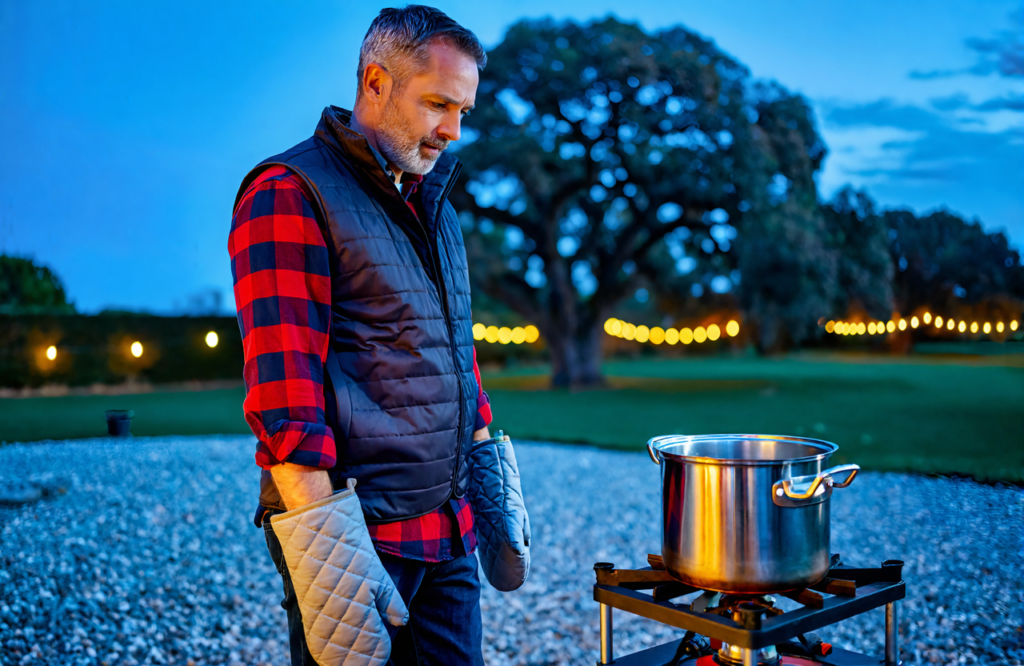
If a fried turkey is on your menu, take this seriously. In that UW Health article, Dr. Faucher said, “Deep-fryer burns are some of the most serious burns we treat, because the oil can be as hot as 400 degrees and clings to clothing and skin, making the burns even deeper.” The same article notes that the NFPA discourages the use of gas-fueled turkey fryers. If you fry anyway, the City of Lafayette, Indiana’s Turkey Fryer Safety page lists these rules:
- Turkey fryers should always be used outdoors a safe distance from buildings and any other flammable materials.
- Never use turkey fryers in a garage or on a wooden deck.
- To avoid oil spillover, do not overfill the fryer.
- Make sure the turkey is completely thawed and be careful with marinades.
- Never use water to extinguish a grease fire.
Inside, the U.S. Fire Administration’s Cooking Fire Safety page says to stand by your pan, turn pot handles toward the back of the stove, and keep a pan lid or baking sheet nearby to cover a pan that catches fire. That matters with little ones underfoot. The AAP’s parent FAQ says that, according to the World Health Organization, nearly 75% of burns in young children are from liquid, hot tap water, or steam. The AAP’s Burn Treatment and Prevention Tips for Families suggests setting your water heater so the hottest temperature at the faucet is no more than 120 degrees Fahrenheit.
And when those first chilly Northshore nights roll in, the USFA’s space heater safety pictograph says to place portable space heaters at least 3 feet from anything that can burn.
Which urgent care is best for a minor burn near Covington?
The best fit for a minor burn is a clinic that’s open when the burn happens, sees you without an appointment, posts what a visit costs, and sends you on to a specialist when a burn needs more. By that yardstick, here’s how Total Health’s walk-in urgent care in Covington, LA measures up:
- Weekend hours: Saturdays and Sundays get the same 7 AM open and 7 PM close as weekdays. That’s handy if a burn happens on a Sunday afternoon.
- No appointment: just walk in, since you don’t need an appointment.
- A clear price: the $130 self-pay office visit is listed on the pricing page.
- Burn care and tetanus shots under one roof: both appear on our services page, alongside treatment for infections.
- A referral when needed: the services page says referrals go out to specialists based on what each patient needs.
Typing urgent care near me into your phone in Mandeville, Madisonville, Abita Springs, Folsom, or Franklinton? You’ll find us close to where Hwy 190 and Hwy 25 cross, a little north of downtown Covington.
Common questions about treating burns
No. Ice and ice-cold water can damage tissue and slow healing. Cool running water is the better choice, and burn experts say to keep it cool rather than cold or icy.
Guidance varies a bit. The American Burn Association says at least 5 minutes, and the American Academy of Dermatology says about 10 minutes or until the pain subsides.
No. Leave blisters alone and keep the area covered. An opened blister can get infected, and an intact blister protects the skin underneath as it heals.
Watch for drainage or pus, fever, increased pain, red streaks spreading from the burn, or swollen lymph nodes. MedlinePlus says to contact a provider right away if any of these show up.
A first-degree burn takes about 3 to 6 days to heal. A second-degree burn can take up to 3 weeks or longer, depending on how severe it is.
Yes, for minor burns. Our Covington clinic offers rapid intervention of minor burns, including prescribed treatment and wound care, with a referral if needed. Large, deep, chemical, or electrical burns need 911.
Possibly. MedlinePlus says to make sure the person is up to date on their tetanus immunization. Our Covington clinic offers tetanus shots after evaluating the injury and your immunization history.
Burned your hand on the gumbo pot or a hot sheet pan? Cool it first, then come see us. Pull up to 73015 Hwy 25, look for Suite A, and you’re there: Covington, LA 70435. Doors are open daily from 7 AM until 7 PM. Not sure your burn needs a visit? Ring us at (985) 400-5370.
Total Health Urgent Care’s team in Covington prepared this burn guide for St. Tammany Parish families. Our practice was founded by Jennifer Duncan, APRN, a Covington nurse practitioner. Read this as general guidance and not as a diagnosis, then check with a provider about your own burn.